|
|
|
|
|
|
|
|
|
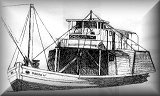
This model of the P.S. Oscar-W can be found in the Alexandrina Council |
Interested in plans for model boats? ~ Please check out this website ~ http://www.floataboat.com.au/ |
TECHNICAL INFORMATION FOR THE BOILER AND ENGINE ON THE P.S. OSCAR-W |
|
HOW DOES IT WORK? |
The
steam from the boiler is used to operate the engine. The steam enters
through slide valves in the block on either side of the twin cylinder
engine. The steam moves the pistons and allows the used steam to exhaust
when used. The pistons are connected to the crankshaft via con rods and this
inturn moves
the paddles as required.
The
crankshaft has eccentrics fitted to it and these cause the slide valves to
move allowing steam to enter and exit the cylinders.
The exhaust steam is exited via the smoke stack and this assists the firing of the boiler with a more induced air draught system thus making it more efficient. |
BLOWDOWN |
From time to time there is a need to remove sediment and other rubbish from the bottom of the water side of the boiler. This is done via the blowdown valve and is used as much or as little as the water quality dictates. The exit of this steam and water mix looks very spectacular to all who are on board and can be quite refreshing if you are standing near its path. |
LUBRICATION |
Lubrication of all bearings is delivered via lubricator sight glasses and wick lubricators. These need to be constantly monitored as this style of engine cannot afford to run without lubrication. The engine cylinders require a different system which works by condensing steam which in turn displaces oil from a reservoir which then drops into the piston area. Recently we have changed the system on the big end bearings and fitted pressurized grease lubricators to give us a more constant lubrication and also to ensure all lubrication goes where it should. |
COMMON ASKED QUESTIONS |
Do we carry water ? Not normally as we draw straight from the river but of late the quality is poor and we use mains water to cruise around the Port. This is held in holding tanks and fed to the boiler feed tank. If this is not enough our blowdown is increased and chemical is added to compensate as much as possible.Can the paddles turn independently? No they can only go forward or reverse together and the turning is done via the rudder.Do we preheat the feed water? Yes this is done in the feed water tank with steam direct from the boiler.What are the parts of the Crankshaft? There are 5 eccentrics attached. 4 to move slide valves and 1 for the short stroke water pump.How does the engine reverse? Each slide valve has 2 eccentrics attached- by moving the forward or reverse gear lever the other eccentric is brought into play ( alters the relationship of the valve to the piston allowing the engine to reverse. This is called a Stephenson Link.Who controls the engine? The fireman or engineer control the engine by levers on the left of the boiler front. The Captain has control of the speed and his commands for whatever are delivered via bell rings. 1 ring is forward. 2 rings are reverse. When moving 1 ring is stop.What speed does it travel at? Approx 6-7 miles per hour depending on conditions at the time. The crankshaft turns at approx 120rpm which is transferred through gears to turn the paddle wheels at approx 26 rpm. |
|
|